What is behind «parfum»?
How fragrance ingredients disappear from labels, and what a new study shows about parabens and phthalates
It appears somewhere on almost every ingredient list: «parfum». A harmless word. But behind it can lie more than a hundred individual substances.
What actually happens in the body when you change your care routine for a month? That is exactly what a research team in San Francisco investigated.
28 days, one signal
41 healthy women avoided products with parabens and phthalates for 28 days. They were given replacements for their entire care routine: shampoo, deodorant, lotion, toothpaste, make-up and more.
Urine and blood were examined before and after. In addition, a doctor took cells from the breast with a fine needle. None of the women had cancer.
The result, published in 2023 in the journal Chemosphere:
- Afterwards, significantly fewer parabens were found in the urine. DEP, a phthalate from fragrance mixtures, also decreased.
- In 12 women, the breast tissue was examined more closely. Certain genes known from cancer cells were less active afterwards. Two women who made no change served as a comparison.
It is a small first study. It does not prove that parabens or phthalates cause cancer, as the researchers themselves say. But it shows that healthy tissue responds to what we put on our skin every day. And it does so after just a few weeks.
Parabens: cheap, effective, and hormonally active
Parabens are preservatives. They make creams and shampoos last longer. They are cheap and reliable, which is why they are in many products.
Some parabens resemble the hormone oestrogen. They can dock onto the same sites in the body. Their effect is much weaker than that of the body's own oestrogen.
The rules in the EU, which Switzerland largely adopts:
- Five parabens have been banned since 2014.
- Propyl- and butylparaben: a maximum of 0.14 %. Banned in nappy-area care for children under three.
- Methyl- and ethylparaben: permitted up to 0.4 %. In this quantity, safe according to EU experts.
The authorities assess each substance individually. What remains open: what does the sum of them do?
One word for over a hundred substances
Fragrance mixtures may appear on the label under the single word «parfum». Manufacturers do not have to reveal exactly which substances they contain.
Only certain allergens must be listed individually. For new products, since July 2026 that has been around 80 substances instead of the previous 24. This helps people with allergies. Everything else remains invisible.
For example DEP (diethyl phthalate). DEP is a solvent and makes a fragrance last longer. If it is in the fragrance mixture, it does not appear on the label. DEP is permitted in the EU and is considered safe in usual quantities. Other phthalates such as DEHP and DBP are banned in cosmetics.
After the change in the study, it was precisely the breakdown product of DEP that decreased. Phthalates from food remained the same. So the change came from the bathroom.
And essential oils?
Plants have an effect, that is their strength. So a close look is worthwhile here too.
In 2019, a US research institute tested eight components of lavender and tea tree oil in the laboratory, on individual cells. Three of them showed a weak oestrogen-like effect, but only in extremely high quantities.
What happens in cells cannot simply be transferred to people. Larger evaluations give the all-clear: a systematic review found no evidence for tea tree and hardly any for lavender. The researchers themselves expressly do not advise against using the oils.
What is true: natural oils can also trigger allergies. That is why bergamot, orange, ylang-ylang, lavender, jasmine and rose are now also on the EU allergen list.
Essential oils are not a danger, but concentrated active substances. As with a good spice, the quantity decides: how much, how long and for whom.
100 % natural. 100 % traceable. Scientifically grounded.
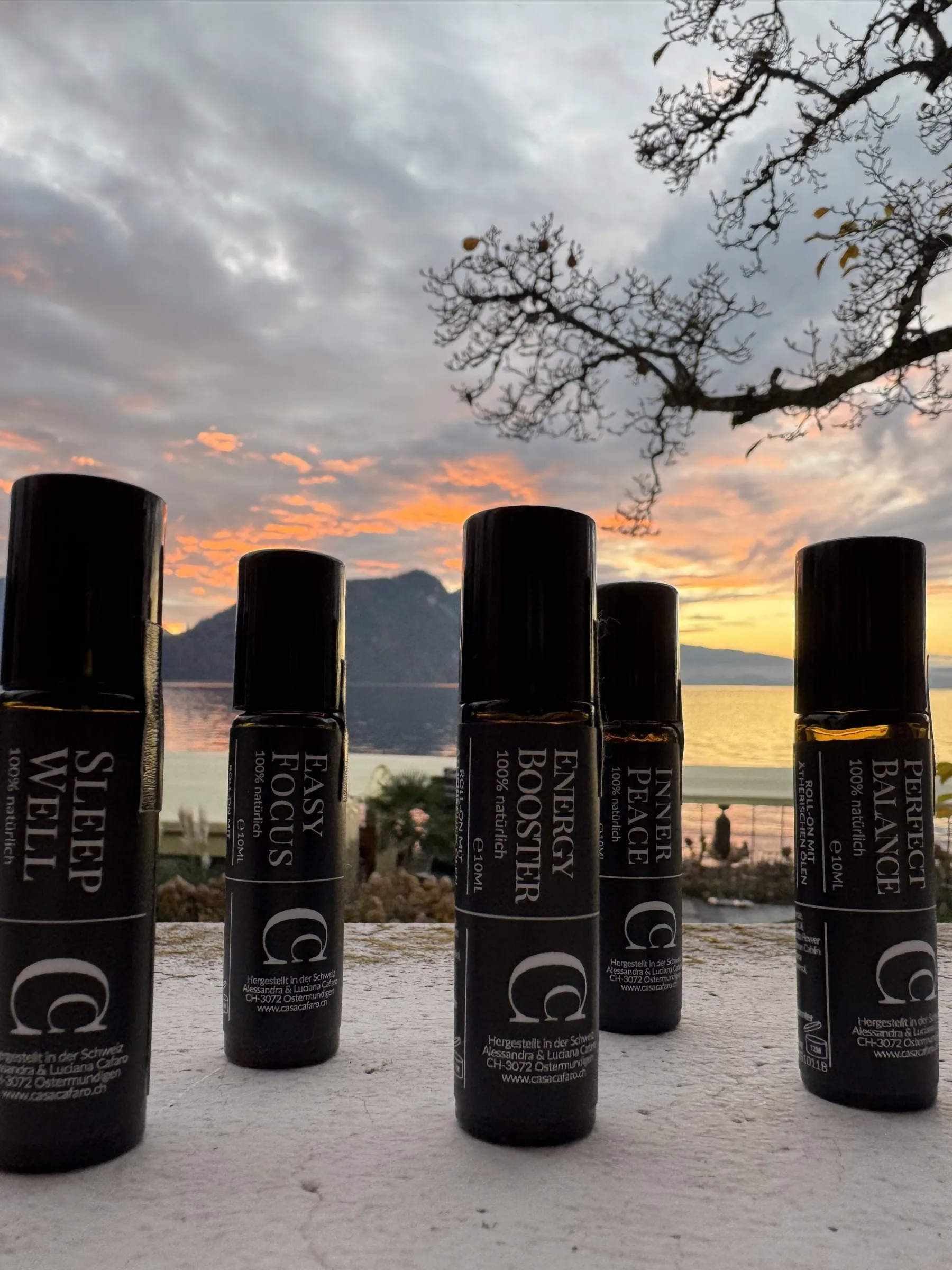
At Casa Cafaro we work only with natural ingredients. Without parabens, without synthetic fragrances, without phthalates.
With us there is no «parfum». We call every oil by its name. So you know what you are applying and breathing in.
We dose deliberately rather than generously, scent rooms with a plan and with pauses, and are consciously restrained around children and pets.
We promise that you know what is in it, and that every drop has a reason.
Frequently asked questions
What should a business look for when buying room fragrance? A complete list of ingredients instead of the umbrella term «parfum». This includes origin, quality testing and clear information on dosage. Anything a supplier does not want to disclose should make you sit up.
What do we tell guests who ask about the ingredients? The truth, in full. For each of our blends there is a list of all the oils. This lets the team answer every question, including those from guests with allergies.
Is «phthalate-free» on packaging a mark of quality? Only to a limited extent. Most problematic phthalates are banned in cosmetics anyway. More telling is whether a manufacturer names all fragrance ingredients individually.
Sources
- Dairkee SH et al. (2023). Reduction of daily-use parabens and phthalates reverses accumulation of cancer-associated phenotypes within disease-free breast tissue of study subjects. Chemosphere 322:138014. doi.org/10.1016/j.chemosphere.2023.138014
- Ramsey JT et al. (2019). Lavender Products Associated With Premature Thelarche and Prepubertal Gynecomastia. J Clin Endocrinol Metab 104(11):5393–5405. doi.org/10.1210/jc.2018-01880
- Hawkins J et al. (2019). The relationship between lavender and tea tree essential oils and pediatric endocrine disorders: a systematic review. Complement Ther Med 49:102288. doi.org/10.1016/j.ctim.2019.102288
- Regulation (EU) No 1004/2014 and No 358/2014 – parabens in cosmetic products. umwelt-online.de
- Regulation (EU) 2023/1545 – labelling of fragrance allergens. MDSS Cosmetics
- European Commission, Scientific Committee on Consumer Safety – Diethyl Phthalate. ec.europa.eu
This article is for information purposes and does not replace medical advice.