A visit to Bulgaria: where our lavender grows
In July 2026 I flew to Bulgaria, to Esseterre, where some of our raw materials are produced. I wanted to see with my own eyes how the farmers work, how the lavender is grown and harvested, and how the plant finally becomes the essential oil we use for our scent concepts.
The field was violet as far as I could see, the sun was warm, and over everything lay this scent. I know lavender well. It grows in my garden, and in my work I have smelled countless lavender products and lavender oils. This one smelled fuller and deeper, yet remained delicate. I even wondered whether I could detect a very fine, almost vanilla-like note in this complex scent profile. Perhaps it was the warm summer air above the earth, perhaps the whole setting.
In the field it became clear to me how many factors go into an essential oil and how early they begin. The choice of plants, location, climate, soil and the right time of harvest all help determine how the oil will later be composed, long before the lavender reaches the distillery.
Harvest and distillation
In Bulgaria, lavender is typically harvested from the end of June to the end of July. At Esseterre, the annual lavender production is concentrated into roughly three to four weeks, and during this time work goes on around the clock. The freshly harvested plant material should be distilled within a day, because its constituents continue to change after harvesting. Temperature, time, storage and humidity act on the plant and thus on the later oil. Buying lavender somewhere and distilling it later is therefore not enough for a high-quality oil.
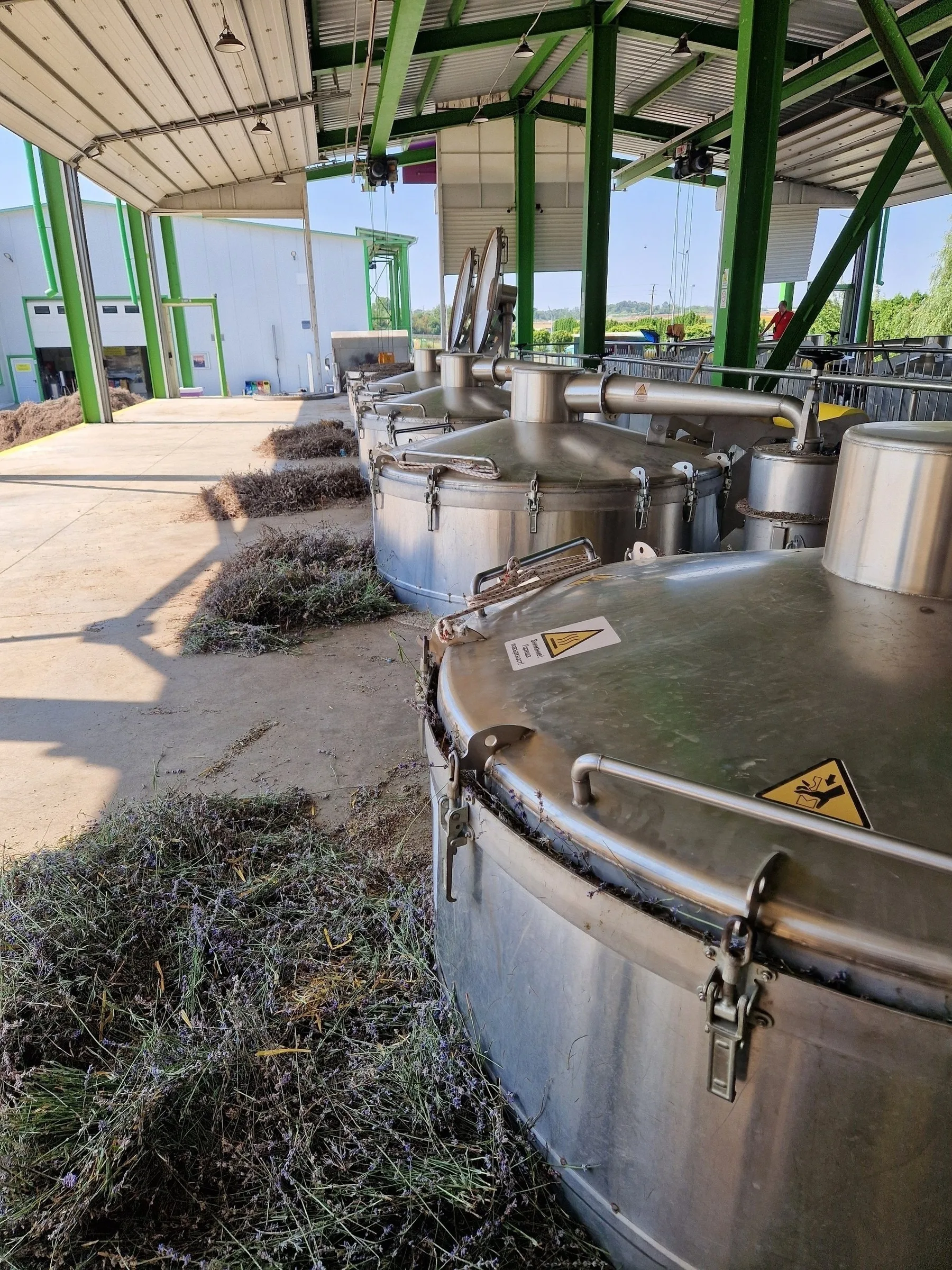
Then we went on to the distillery, and there my first thought was «wow». The field had already smelled intense, but in the distillery, while the lavender was being processed, it was a completely different experience again.
The freshly delivered plant material goes into large distillation units. Steam releases the volatile aromatic constituents from the plants, and from this the essential oil is then obtained. One run takes about one to one and a half hours.
According to current figures, the average oil yield of lavender is around one percent. A 15 ml bottle therefore holds about one and a half kilograms of freshly harvested lavender. When you hold such a bottle in your hand, you do not see this work. After my visit, I see it.
What is in a lavender oil
There is one point from this trip I particularly want to pass on. Even what is natural is chemistry, and lavender oil consists of the natural chemistry of the plant. Lavandula angustifolia forms a complex mixture of molecules, above all linalool and linalyl acetate, plus further compounds that shape the chemical and aromatic profile of the oil.
This composition differs from oil to oil. Scientific studies show clear differences between commercially available lavender oils. Even in a study of Bulgarian lavender oils in which linalool and linalyl acetate dominated, the samples differed from one another. Whether an oil smells of lavender therefore says little about what is in it.
A study of commercial Lavandula angustifolia oils published in 2024 found indications of adulteration in 49 % of the samples, and the researchers were able to identify various forms of manipulation and typical markers for them. The figure applies to the samples examined. It makes clear that origin and quality control are not a side issue.
Of course, one could choose essential oils by price per kilogram. We look at origin, botanical identity, cultivation, harvest, distillation, analytics and traceability, and work with partners where all this can be verified.
The people at Esseterre
As much as the technology, the people stayed with me, the farmers and everyone who works in the distillery. Esseterre describes a long-term collaboration with local farmers and employs specialists on site in agriculture, distillation, engineering and the laboratory.
Bulgaria has a long tradition of growing aromatic plants, and the region around Dobrich, with its climate and soils, offers good conditions for lavender. Esseterre was built there to work close to the raw materials and the local producers, and the distillery lies right next to the lavender and lemon balm fields. Because farmers, agronomy, distillation, laboratory and research are so close together, what happens to the plant remains traceable. In long supply chains, this transparency is quickly lost.
I want to know who grows a plant, how it is worked with, how the people behind it are treated and how we treat nature in the process. For Casa Cafaro, all of this is part of a responsible value chain, and with such raw materials we want to create products we can stand behind with a clear conscience.